For me, the coronavirus outbreak was both a horrendous tragedy and a once-in-a-lifetime gift. It was a calamity that threatened everyone on earth and melted away the hierarchies that separate us. We were just human beings for a while.
In the blackness of quarantine, I became invisible. Free from the constant daily interactions that always seemed to lead me to think I somehow wasn’t doing things right. From the self-consciousness that plagued me: how I was perceived, how I was judged, how I measured up according to the rules of the arena I found myself in.
The quiet darkness hid it all. I was simply a soul. A human being in a family of human beings.
This is why I am not eager to go back to the way things were.
I don’t want to try to fight my way into society’s detailed ranking, its tight grid. I don’t want to be aware of how I do or don’t fit in, where I stand in the graph — high or low, left or right.
I don’t want to look at everything I do through the lens of the groupthink to decide whether I am good or bad, worthy or worthless.
“I am a man.” I love this declaration that I see on t-shirts in Black Lives Matters marches. It helps me rewrite the limiting scripts in my mind. When I see a Black person I don’t know, I feel the assumptions my mind is making, and then I say over it, “Man.” Or “Woman.” Or “Child.”
This is the way I want to be seen. I want to see others this way too. Greeting each person as a human being makes me feel part of a One, not a fragment among many. When I see someone and “human” is all I need to know about them, my heart speaks, not my mind, and compassion flows out.
Every country, every society has a unique hierarchy. People not born with the qualities that are valued at the top will most likely struggle to feel loved and accepted, always feeling they are on the verge of being kicked out.
I love people. I need people. I crave connection and soul-to-soul communion. People cooperate, lift each other up, make each other feel less alone, become the safety net. We help each other survive and thrive.
But there is something about large groups that leads us to categorize and place value on people based on what they do, what they look like, how much they earn, or how assertive, outgoing, or fashionable they are.
Perhaps this is why I am not heartbroken that our world will stay small and that our house will become a school this fall. School — even as a parent who only is involved with fundraisers and drop-offs, field days, plays, and graduations — brings back the same feelings I had as a child: I’m different and I’m afraid of what I have to do to belong.
I feel sad for my children, missing all the happy nurturing things about school and playing with friends in the sunshine. I feel sad for my daughter who will start her senior year on a computer. The suffering inflicted because schools are not opening is devastating. It’s a sign of massive dysfunction, and I feel a sense of dread as I witness the institutions and economies that support the livelihoods of so many people continue to deteriorate.
This is why it is so hard to reckon with the fact that I am okay with keeping the social, busy, public part of my life in the dark for a while longer, and clinging to the peculiar warm light I have found in the wreckage. Because as much as I grieve our losses, there was something unhealthy about the way we were, and something healing about what is now.
When you are so busy throwing stuff into the shell of your body, you don’t realize that to feel fulfilled, you must simply stop.
The sound trickling in is not water rising to drown you, but the sound of your own self coming into its rightful space.
Nothing can replace this ‘being one’s self.’ That is why you keep running, seeking, rushing, doing — desperate to fill the emptiness you fear.
Your longing is the longing for your own self: your own love, your own trust, your own intuition.
Sometimes you feel that you are an empty riverbed. A ditch that can never be brimmed, never satisfied.
Don’t be afraid of this blackness. It is what connects you to everything that ever was and everything that ever will be. It is what everything springs from and dissolves into. This is the power you are afraid of. The unknown, the endless, the incomprehensible.
Don’t fill the emptiness with small tasks and petty demands and a million directives from your in-box, your to-do list, and your self-help books — they will never be done, and you will never be full.
Don’t fill it with someone bigger, more powerful, more charismatic and brilliant than you — this person will leave and you will be alone again.
Don’t fill it with what you want to buy, become, create — if these things come, you will still feel something is missing. Even when your arms are full, even when you have everything you asked for.
These glimmering, brightly-colored, squeezable things — they are always morphing, growing, disappearing. You can never hold them and be done.
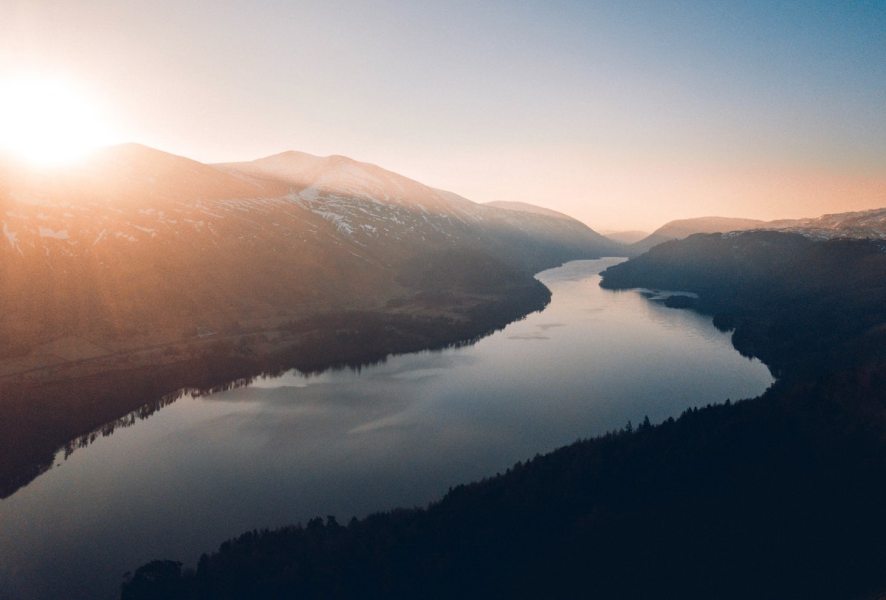
Only water can satisfy a riverbed. Only the part of you that is connected to all the streams, all the oceans, the lakes, the waterfalls, the floods and fjords that circle the world. The river of life that never ends and never begins.
Jack Anstey/Unsplash
Let all other things be washed away, all that has blocked you, obstructed you, made it impossible to hear the sound of your river rippling, to taste the flavor of your own soul.
In the stillness, your breath is a wave, coming in and going out. The knowing will eventually come, flowing through you from somewhere deep inside, filling the space you thought was vacant.
My daughters are bingeing on ‘Game of Thrones’ on the screened-in porch, trying to finish the entire 8 seasons before Sofia goes off to college. Mark, Luke, and Diana are playing badminton in the dwindling August twilight.
After dinner we rode bikes down to the convenience store on Route 50 to buy a gallon of milk. I strapped the last gallon they had to the back of my bike and rode home with Juicy Drop Pops and Reeses cups in a Par Mar Stores bag hanging from the handlebars.
The kids bat at the birdie with rackets too long for them on a span of grass a thousand times larger than the patch of weeds behind our house in D.C., and I want them to play as long as they can, to soak up this freedom until they’re full, because in a few days, they’ll be back to a city playground, and school will start on a computer screen, and for a minute I worry that they don’t have enough.
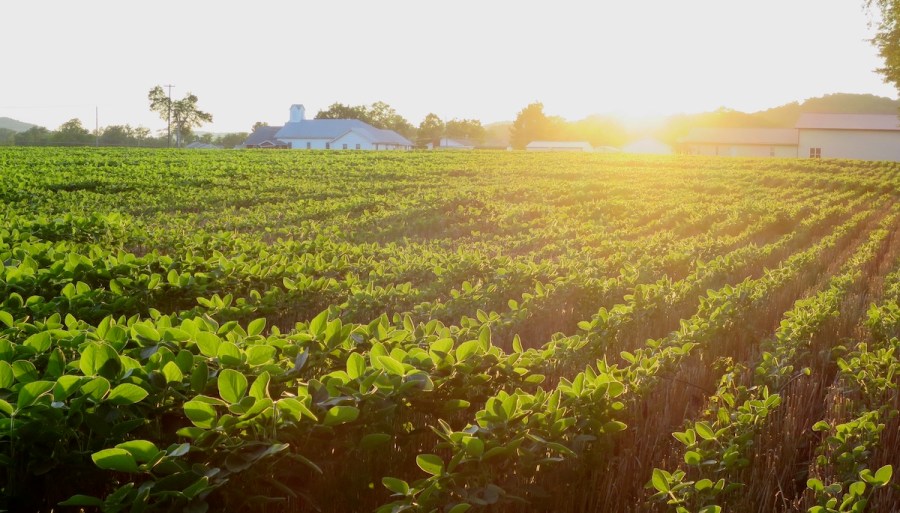
Somewhere beyond the pasture, a conch-shell sun lights up a mass of clouds that plods across the sky like an ocean liner. When I stay right here where I am, in this moment, in this Ohio countryside, there is no problem. I am not in pain. No one is mad at me, I am not late, I am not wrong. There is nothing I am supposed to do, nowhere I need to go.
How long can I stay here, encapsulated in this moment, like an unbroken bubble, a piece of taffy that stretches and stretches, a smooth highway that never ends, before my mind breaks off and goes somewhere else? The explosion in Beirut, the upcoming election, the email with no response, the virus spiking in Florida, Mississippi, Georgia —
If I begin spinning intricate adult coloring books in my mind, who is inhabiting the life that is already colored in right here?
From my armchair inside the cottage, I hear crickets making long dashes in chirring morse code. The children are now meowing in the basement pretending to be adopted kittens who don’t know how to brush their teeth. The clouds have made a blue surfboard and a shaving cream spume against a sky of cotton candy and butter. The trees are navy green silhouettes and the black fences are disappearing into the fuzzy green pasture.
This stillness I feel when I pay attention to my life right now — this awareness, this in-ness — is where answers will come from. I look elsewhere, but if I would just be, the wisdom, the knowing, the right thing would come to me.
‘Chock, chock’ goes the clock on the wall. The shadow under my 12-year-old’s chin, the freckle there, the way my 10-year-old looks into my eyes when I really see him. The 6-year-old sucking her thumb, wet hair on the pillow, saying she is grateful for ping-pong.
When I am inserted into this life, I am connected with everything that is here and the knowing that pervades it all. The cicadas who know what year to crawl out of the ground and how to call a mate, the grass that knows when to start growing — the moon how to orbit the earth, the dog where to give birth, the tomato seed how to make another tomato, the horse how to die.
Photo by Amy Suardi
There’s a place on every staircase where the notes of the lullaby amplify and round and deepen. I sing ‘You Are My Sunshine’ with ‘du-du-du’s instead of words as I stand on the stairs up from the children’s darkened room, and I wonder what they look like in their beds. Are they sad, are they disappointed, have I done enough?
If I could live my life one full-bodied moment to the next, I wouldn’t need to worry about what’s going to happen, to practice what to say, fuss over what I’ve messed up. If I weren’t interrupting life all the time, trying to rearrange it, I would take each challenge as it came.
If there were more escapes like this one in the country, more eddies in the river of life, where I could sleep when I feel tired, be alone when I need space, let sadness rest in me when it comes. If I could shut off the wind turbine so all my thoughts would flutter to the ground and I could see for a while.
Because in this clearness, I know that I wouldn’t need to worry so much. I wouldn’t need to try so hard. In this stillness, I would know when to cut, when to mend, when to run, when to embrace, when to apologize, when to be silent, when to act, and when to let it be.
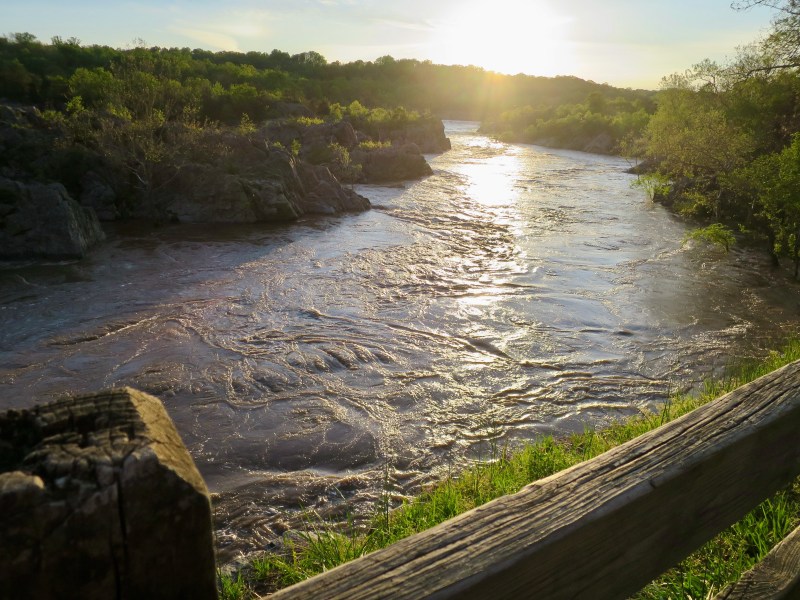
I went down to the river today. It felt like touching the feet of God.
I hadn’t driven a car in a month. Weeds were growing around the tires. My phone was dead so I drove there without a GPS. I felt grappled to the earth. I got lost.
Cars were parked all over the shoulder by the trail heads like beetles to nectar.
Sometimes you can be too safe. Like a plant in a pot, your roots go round and round and nowhere. The walks we take around our neighborhood. Nature is not tame like this. Landscaped bushes, tulip beds, Dogwoods placed like armchairs in the corners of yards.
In the woods, trees are dangerously high. Others lie dying at their feet. Black Vultures circle high at the edges.
Table manners, Office 365, social media headshots, calorie counts, rankings: what does all this matter?
Violent beautiful nature. I feel calmed, sobered.
I came back to the river at sunset with my family. I want to give them more than errands for shampoo and canola oil, or bike rides to parks where security guards shoo us away.
We take foot bridges over the punching water of the Potomac. It rips over black bedrock. Diana is scared. She knows the river can kill you.
I want to know that it is possible to die. This fear stops me from tinkering with dials and buttons, and makes me look up at the sky, and feel the clay under my feet.
Almost every day since the coronavirus outbreak, I have felt sick in some way. My throat has been itchy and warm, or the inside of my nose fiery and blue. Sometimes my brain pulsates, my sinuses explode with a fluorescent sneeze, or my stomach twists like a rag being wrung.
When I was sick last December, I would wake up from a nap and feel my lungs aching. Normally my organs work without my thinking about them, freeing my mind to wander here and there, dream of this, worry about that. My body was telling me, “Pay attention to me. Remember me.”
We think of sickness as a sub-optimal state, but when we are attending to our bodies, we are no longer taking long strange journeys with our minds. When we are quiet in bed, all the pretenses fall away, leaving something simple and precious.
When world leaders and movie stars and princes get infected by this virus, I feel a tenderness toward humanity. These once intimidating highflyers suddenly seem like people who could be in my backyard for a grill-out, chatting with me about the kids and this crazy world and what happens when you die.
When we are healthy, the subtle sensations in the body mostly go unnoticed. The relative stillness and self-sufficiency of the body seem to tell us to go – do – strive.
Sickness can be an opening to the soul. When I am ill, I am no longer the person I want people to see, but the person I was before I knew my name. Being sick temporarily breaks down the constructions that separate me from everyone and everything.
When I tuck in my six-year-old daughter tonight, she says she’s grateful for ice cream. Then she takes my palm and, with her eyes closed tight, kisses it and says, “Even if you wash this hand, the kiss will stay.”
I had been feeling sad that afternoon. And mad at myself for feeling sad. I should be over this. I should be getting better.
I took a walk by myself through the cold damp, taking the alleys, the secret ways of the neighborhood: broken gates swinging open, moss growing on tree roots, window sills rotting.
Fellow walkers stayed so far away, out of kindness or fear, that our eyes couldn’t meet.
Yesterday my 16-year-old daughter Virginia painted her room frosty pink over the Dalila yellow she had chosen when she was 10, and placed purses and sexy clothes on the shelves which used to hold Keira Cass novels and encyclopedias of Greek mythology.
I find the turquoise leather Holy Bible that my aunt gave her and its onion-skin pages remind me of my grandmother, who would underline passages with a ballpoint pen and a ruler, passages that I didn’t understand but that seemed mysterious and important.
I find the poem “A Time for Everything” in Ecclesiastes on page 841. It says that everything is supposed to be this way: there is a time to mourn and a time to dance, a time to tear down and a time to build, a time to search and a time to give up, a time to be born and a time to die.
In my bedroom after my walk, I can hear Virginia chopping broccoli downstairs, playing Whitesnake songs I listened to when I was young and new Dope Boy ones I don’t understand. My children are becoming adults. I am getting older too.
I thought this life was going to be safe. I have not been a refugee, a revolutionary, a migrant. A minority, a wounded soldier, or a widow. I have been spared the trials of being hungry, poor, or homeless. It has been a stable existence, rocked only by dramas of my own creation.
But all our scientific advances and smart phones and futures trading were not enough to save us from this plague.
When I tuck my 9-year-old son Luke into bed, I sing him “Amazing Grace,” as I have done since he was an infant with a silky-border blanket. I touch his slight, smooth arms and know they will be bigger than mine one day. He doesn’t think his lullaby is as special as the one I sing to his sister, “You are My Sunshine.” What is a wretch, he asks, and how can you see if you were blind?
But this song gets to the heart, the opposites bundled up inextricably into this one big life. Yet I keep insisting on strength without getting hurt, rest without feeling exhausted, understanding without confusion, courage without fear. Where tyranny was missing, I have created my own oppression of easy smiles, bouncy optimism, and relentless self-improvement.
I lie in my bed after the children are asleep, the older ones quiet on their screens. The cat who disrupts my slumber too early every morning rests his purring face into the curve of my hand.
The kiss is what stays. I feel it as she sleeps and I am still. It’s something strong yet untouchable, like love. I want to hang onto the sunshine, push away the storms. But there’s something that infuses and encircles it all. And the only way to hold onto it is to somehow let go.
The world is quiet, like a winter day when giant snowflakes fall one by one until everything is thick and round, telling us to stay home, go back to bed, play.
Every weekend now is a family weekend, every meal is a table set for seven, every night children are all safe in their beds.
Now is a time when it feels natural to write a letter by hand, to call a friend and talk long, to make rolls from flour and salt when the shelves are bare.
But how can I love this life when it’s covered with the blood of sacrifice? How can I know this joy when it is lifted from the shoulders of misery?
I confess that I dread the glorious day when normal life opens up again.
When our calendar will be colonized like a strategy game being played by ourselves and others on the territory of our lives.
When I will once again take up battle with my princesses about what they are wearing, where they are going, and who they are with.
When I am alone in the crowd and feel like a girl in a rushing windstorm, trying to find my way home.
I am powerless to direct the evolution of the world. The only thing left to do is ask.
May this time change me. May it open me to suffering I have not let myself feel, to beauty I have not stopped long enough to see.
Show me how to sit in my own heart, so that when it is time, I may walk gently into this new world and not lose my way.







 Painting with Words