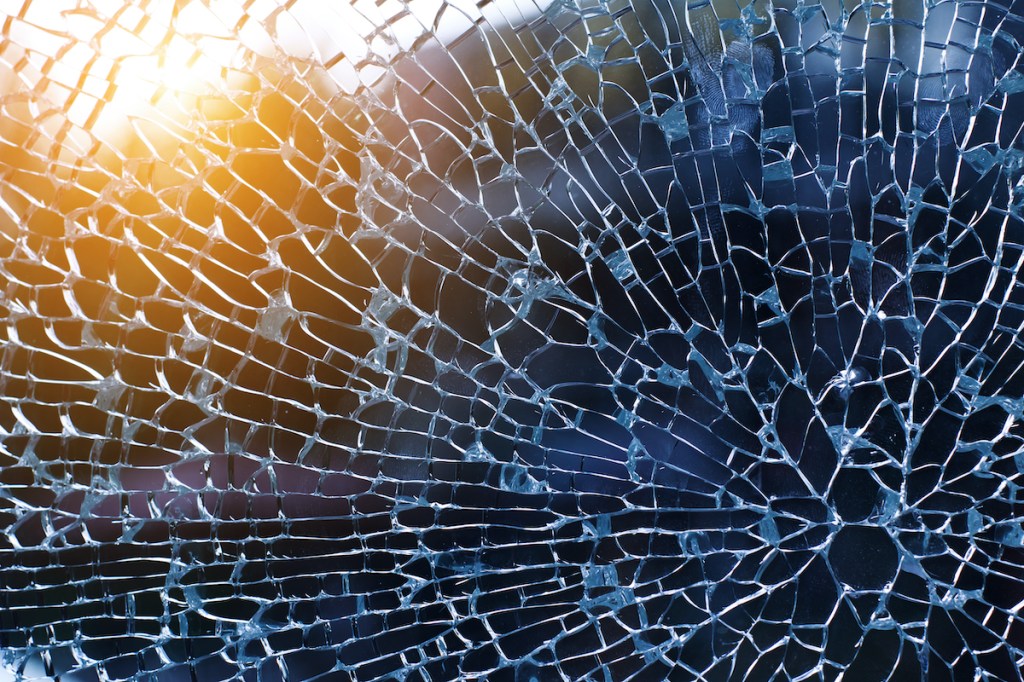
A giant tree limb fell on our car yesterday. The car’s back looked like it was broken: roof crushed, rear end bent, tires kneeling to the ground. Black glass was spattered everywhere.
It didn’t look like I’d ever drive it again.
That night Diana asked if she could give me a face massage and a hand massage and a foot massage after I tucked her in. She touched my eyelids and my eyebrows, pressed her tiny finger pads into my forehead, along my cheeks, the whole length of my lips. Everywhere she touched, a prickly metallic layer under my skin melted away.
It’s just a car, I had said when we saw it there. We have insurance, shielded as we are from the buffeting winds of misfortune by our position, our color, our nest egg.
Diana asked if she could hum when she was massaging my hands, and “Is it okay if it’s just a made-up song?” She stroked the tendons on the backs of my hands, squeezed the tips, intertwined her fingers in mine and wiggled the forgotten crooks. She squeezed the fleshy parts — the heel, the ball — parts of a body that work without being acknowledged.
It’s just a car, but it was the car that Sofia and I had just driven to her first semester at college. The car that had taken us on 5 Thanksgiving trips when all the kids were living at home, summer visits to the grandparents, Christmas pilgrimages, missions to Dutch Wonderland.
Diana takes my feet. Having my feet touched has always felt like being in the hands of Jesus. It touches someplace deeper, more sensitive, a place both loving and needy.
We were at the pool when the limb broke. I had wanted to give the kids something more than riding bikes around the block, and it would be closing soon. The rains come almost every day now, the cone flowers have all turned black, and every last day lily has bloomed.
Something is dying in me too: a hope, a brightness. An opening is closing. When will I be able to bear this? When will I know that this is what happens when something else needs to be born?
“Why does it feel so good to be touched?” Diana asks. We are part of a whole, I say, and touching makes us feel less separate. Touching someone else is like touching our own selves.
The broken car, schools closing, summer waning, blossoms fading — they are all here to show me, again, that nothing lasts. And everything is special.
long8614/Shutterstock
Diana asks if I could give her a face massage. I run the pads of my thumbs over her plump cheeks, around the backs of her ears, and over her scalp and behind her neck.
There’s something different about this type of touch. Unlike a hug or a kiss, it does not need to do the work of communicating. It conducts something that we can’t control, that we don’t need to control, that will flow whether we do anything or not. Touch recognizes what is in each of us and allows it, unfettered.
I say to myself that I’m okay with this loneliness, this quiet, solitary life. But the tension builds, the silent grief, the continual battering of what used to be, the howling of what needs to die but won’t. And the pain sits there in a parking lot, keys hidden under the mat, until a tow truck comes to take it away.
The last time I saw the car, an orange caterpillar was inching up the curve of the wheel. I wonder if it felt lost, or if it knew it was just finding another way.
I had never been to the college our daughter had chosen. Sofia had visited Kenyon with my parents, and I knew that my grandfather and uncle had gone there, but my April visit was canceled due to the outbreak. So when it was time to go on August 26, I wasn’t sure where she was leading me.
The route we normally take to Ohio got us only halfway, then we had to turn north toward Uniontown. We climbed the jagged mountains of Pennsylvania past historic battlefields, pre-colonial stone houses, and painted images of young George Washington in his ruffles and blue velvet, and I felt the same rush of awe and drama that I did when I went to college in New England. The East, with its founding history, plaques and pedigree, felt majestic and weighty. I instead felt like any girl from the cornfields of flyover country.
Kenyon told kids to pack light in case they had to move to a quarantine dorm, so the car was only half-full: a full-length mirror, a fan and a lamp, an area rug and a duffle bag of clothes, plus some photos to decorate the double Sofia would occupy by herself on a campus populated with only freshmen and sophomores.
When I went away to college, the kids I met who grew up in cities along the coast were worldly and impressive. It was easy for me to go from a silent admiration of Manhattan, Boston, Exeter or Choate to a full summation of the associated person as intelligent, powerful, even heroic.
As Sofia and I drove over the National Turnpike, American flags flapped around historic inns and famous taverns and I pictured revolutionaries in ragtag uniforms 300 years ago mapping attacks against the British. On this day, much of the red, white, and blue was supplied by yard signs and flags emblazoned with “Trump-Pence 2020.”
The problem with sanctifying people is that everything else becomes profane. My idols shone so brightly there was no choice for me but to be dull. Destined to chase after them, waiting for benediction.
After Sofia and I crossed the Ohio River into my home state, I felt the let-down of the Shoe Carnival strip mall where we stopped to get coffee. The freeway we took, bland and monument-less, was wet from a storm, but I couldn’t help notice how the water streaming over the concrete shimmered like platinum in the late afternoon sun.
An hour later we would slow down at a college campus of Gothic Revival sandstone that tapered into a row of clapboard markets, Victorian houses converted into academic departments, and a post office with a weathervane cupola.
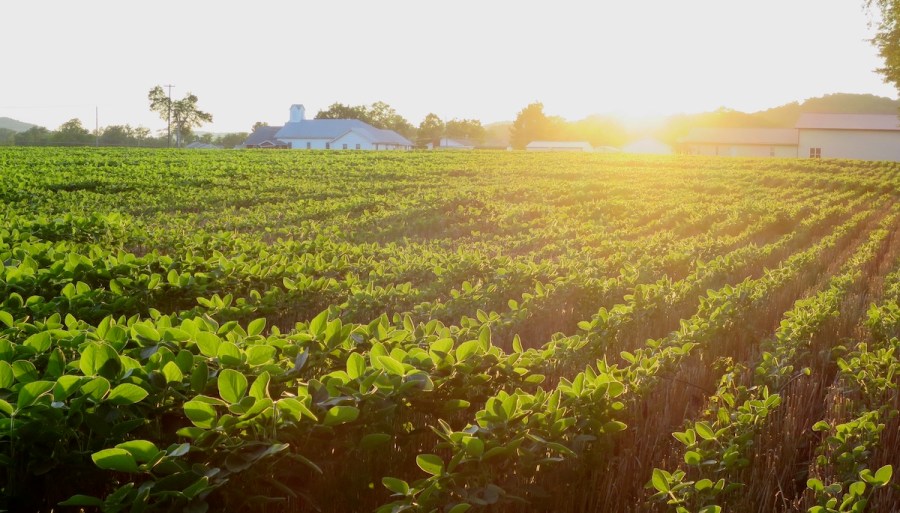
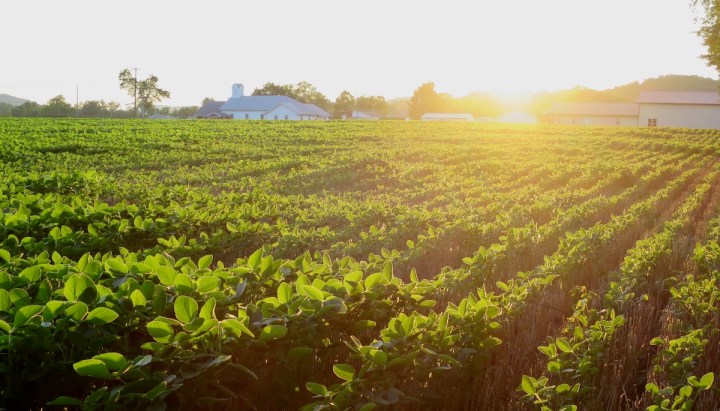
But before that — when we first bumped onto a 2-lane country road and I knew we were getting close — I rolled down the windows. The air smelled like watermelon and hay, wet fields and crickets. The road tossed us up then held us tight, like a swing at the elementary school playground. We drove past velvety blue soybean fields and tin roof silos, barns taken back into the earth by vines and houses with their paint all rained off, piles of wild honeysuckle and fences fashioned of hay rolls.
Here was the Ohio countryside I couldn’t wait to leave when I was 18. It was so beautiful, in the quiet way that home is. Something I wouldn’t have recognized back then, even if it were right in the mirror in front of me.
Part II
On a day that started with covid self-testing in an athletic center but had no departure deadline, I didn’t know how long to stay. Sofia didn’t seem to need me to leave — except for when I walked too slow or the time I said “micr-o-wave.” There were so many things to do: hang up mirrors and smooth on sheets, unwrap new duvets and take ‘before’ and ‘after’ pictures. I wanted to buy her everything that was missing — a phone charger, a box of tissues, the books she hadn’t ordered yet — as if currency would cease to exist when I left.
Then her Reebok’s came unglued, the only warm shoes she had brought, and there was still time after eating General Tso’s tofu from the dining hall on a secluded spot on the lawn to drive out to Lowe’s for contact cement (and another fan for her room).
When that too was assembled, and I could see that the new lightbulbs made her room a little cozier in the darkening evening, I said, “Well, I guess I’ll get going now.”
She gave me a long, long hug, and said, “Thank you so much for helping me get everything all set up.” She insisted on walking me to the car and, in that moment I became unsure of who was leaving who.
As I drove away toward the hotel, shirred clouds of peach and rose and amber glowed against a sea blue sky. It felt like traveling inside a conch shell. Was launching an 18-year-old like spiraling deeper into life or opening outward?
I thought about how delicate she seemed: her slight frame, her porcelain skin, her detailed and careful ways. I wanted to cradle her and deliver her to the next person who would take care of her. But as she had watched me drive away, she was calm, contained. She didn’t look like she was searching for idols.
It was a quiet freedom that she was getting, a sober one. Not the wild one of my college days when I expected a pinnacle, lashing out against life if it didn’t deliver. It was a freedom that we were aware could be taken away at any point. I had the feeling that she would take every day gently in her hands.
I tried to take pictures of the sunset outside the hotel, but the camera only captured the telephone poles and the taillights of a car driving away. The sun went down and the fountain kept tinkling and pickup trucks kept rumbling around the square as if nothing had happened that night.
Part III
On the drive home, sadness did not come in a flooded rush. It was more like a thread, a thread that had to stretch so far it would always be tight.
Like a spider’s silk, it is only visible in certain lights, when it shines like a sliver blade. You feel it when you’re trying to go somewhere and you get all tangled up. But even if no one else senses it or sees it, I know it is there. It is always there.
Late August has always felt like an ending and a beginning.
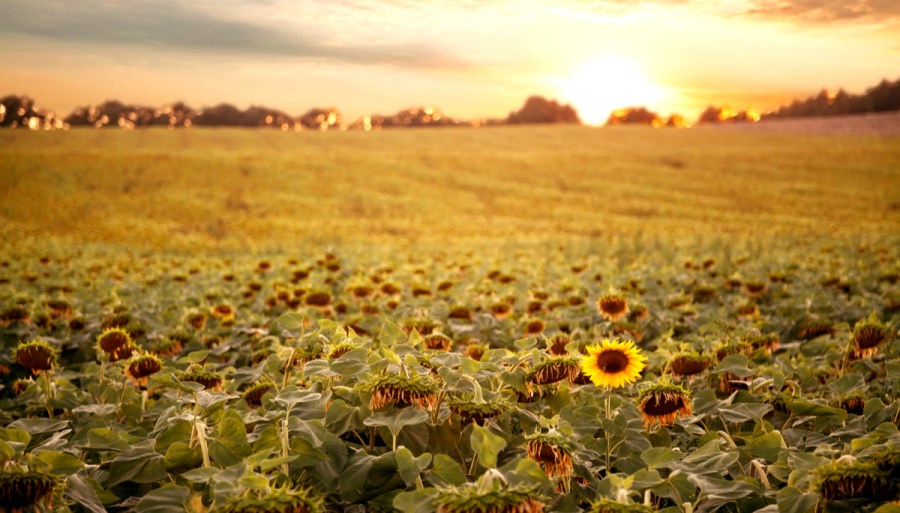
Sunflowers don’t make plates of seeds anymore, cicadas sound more desperate in their güiro song, powdery mildew makes pumpkin leaf parchment, and cooler days discourage cannonball plunges in the pool.
The compensation for turning down summer’s brightness has always been school — fresh-cut notebooks, the waxy smell of never-used crayons, the polish of first-worn leather shoes. New projects, new friendships, new resolutions — the start of school always felt more like a new year than January 1st ever did.
But this year late August feels like a tapering off, a pinching of growth, a withering.
Good public schools have been a uniting force, but now people are moving abroad, switching to micro-schools, hiring tutors, forming learning pods, or simply logging in by themselves at home. It feels like we are particles after a big bang — slowly moving apart before we know what we are coalescing into.
I need a beginning, but I don’t know where it is anymore.
The earth starts turning away from the sun at the height of summer, and by August squirrels are hiding acorns under bushes, and crape myrtle petals fall slantingly like rain. The carefree parties that never were this summer are waning; the vacations that didn’t happen are over.
No longer can I depend on the events and milestones that used to mark the time — the splashy first day of school, the big neighborhood block party, or the exuberant high school musical. I can no longer rely on drop-off for my daily social interaction or eye contact with a teacher to know my kids are doing okay.
aragami12345s/Shutterstock
Just beyond the new beginning, fall has always seemed to say, You’re on your own. Time to get serious and prove yourself.
This year I will be surrounded by children in our cozy home, but I still sense the familiar foreboding. The race to be good enough. The cool kids. The jostling for attention. The longing for a savior when I can’t do it anymore.
Maybe what is ending this odd August is joining the major stream. And what is beginning is the discovery of the tributaries, quiet and meandering, that I have not been brave enough to follow.
For me, the coronavirus outbreak was both a horrendous tragedy and a once-in-a-lifetime gift. It was a calamity that threatened everyone on earth and melted away the hierarchies that separate us. We were just human beings for a while.
In the blackness of quarantine, I became invisible. Free from the constant daily interactions that always seemed to lead me to think I somehow wasn’t doing things right. From the self-consciousness that plagued me: how I was perceived, how I was judged, how I measured up according to the rules of the arena I found myself in.
The quiet darkness hid it all. I was simply a soul. A human being in a family of human beings.
This is why I am not eager to go back to the way things were.
I don’t want to try to fight my way into society’s detailed ranking, its tight grid. I don’t want to be aware of how I do or don’t fit in, where I stand in the graph — high or low, left or right.
I don’t want to look at everything I do through the lens of the groupthink to decide whether I am good or bad, worthy or worthless.
“I am a man.” I love this declaration that I see on t-shirts in Black Lives Matters marches. It helps me rewrite the limiting scripts in my mind. When I see a Black person I don’t know, I feel the assumptions my mind is making, and then I say over it, “Man.” Or “Woman.” Or “Child.”
This is the way I want to be seen. I want to see others this way too. Greeting each person as a human being makes me feel part of a One, not a fragment among many. When I see someone and “human” is all I need to know about them, my heart speaks, not my mind, and compassion flows out.
Every country, every society has a unique hierarchy. People not born with the qualities that are valued at the top will most likely struggle to feel loved and accepted, always feeling they are on the verge of being kicked out.
I love people. I need people. I crave connection and soul-to-soul communion. People cooperate, lift each other up, make each other feel less alone, become the safety net. We help each other survive and thrive.
But there is something about large groups that leads us to categorize and place value on people based on what they do, what they look like, how much they earn, or how assertive, outgoing, or fashionable they are.
Perhaps this is why I am not heartbroken that our world will stay small and that our house will become a school this fall. School — even as a parent who only is involved with fundraisers and drop-offs, field days, plays, and graduations — brings back the same feelings I had as a child: I’m different and I’m afraid of what I have to do to belong.
I feel sad for my children, missing all the happy nurturing things about school and playing with friends in the sunshine. I feel sad for my daughter who will start her senior year on a computer. The suffering inflicted because schools are not opening is devastating. It’s a sign of massive dysfunction, and I feel a sense of dread as I witness the institutions and economies that support the livelihoods of so many people continue to deteriorate.
This is why it is so hard to reckon with the fact that I am okay with keeping the social, busy, public part of my life in the dark for a while longer, and clinging to the peculiar warm light I have found in the wreckage. Because as much as I grieve our losses, there was something unhealthy about the way we were, and something healing about what is now.
“Everything is happening good before my birthday!” said my 6-year-old daughter.
”I learned how to blow bubbles with gum,
“Frankie went on me when I whispered into here,” pointing to the cat’s ribs, “‘Please go on my lap, Frankie’ and he did!
“And my tooth fell out — and now I have one grown-up tooth and 3 wiggly teeth — and only 2 days ’til my birthday!”
And today, the day she turned 7, she put on a blue party dress with yellow flowers and a big ribbon in her hair, and it was raining, so her friend wore a mask, and they ate pizza in an empty restaurant.
“I have to wait ’til Saturday so my dad can see me open my presents,” she told her aunt on the phone, and after dinner she shared the remains of her Birthday Cake gelato with her brothers and they took turns taking spoonfuls until it was all gone.
To get across Maryland, West Virginia, half of Ohio, and the Allegheny Mountains in 7 hours, all that is needed is to depress a pedal on a machine with flying wheels. You don’t even have to press it that hard to go 70, 80 miles per hour. To walk over that land, it would take more than two weeks, two weeks of hiking and laying your head down in a different place each night.
It took us 1/3 of a day to disappear from a hilltop in southern Ohio where a brunch was shared with grandparents under a locust tree, and reappear at a stucco house in an Eastern seaboard city where yards are arranged in checkerboard squares.
There was just a skin of light left when pulled into the driveway, enough to see that the zinnias had grown taller than Diana in the week that we were gone.
“What’s this?” Sofia said when she pulled out a scraggly weed at the top of the cooler packed with milk and butter, green peppers and tomatoes from my mother’s garden.
When you’re flying in a spinning machine because you want to get home before dark, you only touch your feet to the ground but once or twice.
The weed looked like a shooting star firework, its skinny seed pods shooting off the stalk, each with a single white floret at the tip. The type of flower that grows in the shade.
At the rest area off I-79 near Clarksburg, West Virginia, the kids sat around a cement picnic table by the bathrooms sharing M&Ms and an Orange Crush from the vending machines. No one wanted to relocate their snack break to the shade of trees at the top of the hill.
I left my shoes in the grass by the car and walked up to the band of shade. But instead of the grass ending, the trees simply parted, the grass unrolled up the hill, and soon I found myself in a clearing in the middle of a small wood. Some kind soul had swirled a mower up here. This place was meant to be discovered.
I could no longer hear the whining of trucks over the freeway. Instead the steady ring of crickets. Sunlight — bossy and yellow in the outside world — sifted through the trees and came out blue and hazy, filtered with drifting bits.
A mowed path led further into the woods. The ground felt spongy and cool on my bare feet, and I bent down and saw that it was not moss but a blanket of miniature fern fronds. The smell of damp things — creeks, dragonflies, spores. A blue and black butterfly danced up and around the path.
Of the weird things in the cooler, I told Sofia, “Oh, those are my artifacts.” But the shooting star flower, the wild daisy, and the purple thistle I had tucked in there were now twisted and black like things left over after a fire.
Once we got the kids in bed, cat fed, food put away, and some clothes unpacked, I had to lie down. It wasn’t that late and I felt I hadn’t done much of anything, but all the cells in my body were still tumbling and rolling over like those tires, and I needed to stop so that everything could come to rest.
It’s not natural to move a human body so far in a day. It seems so ordinary, so inexpensive, to get from there to here with only a map and a tankful of gas. But at that velocity, a single glance away from the road, a fumble with the air conditioning dial, or a slight bump of the wheel, and we could have all been killed.
“Naturalized Area,” I noticed a sign said after I wandered back down toward the picnic table and parking lot and looked back up at that secret garden.
I guess when you let things be natural, they get magical like that — they smell like dew, they turn sunlight the color of water, they carpet paths with fern moss, they bring striped bees and Monarch butterflies to the rose velvet tassels of Joe-Pye weeds.
Maria T Hoffman/Shutterstock
Thank you God for rest areas. Those modest harbors where you don’t have to buy anything to use the bathroom or wash your hands. Where you can sail off the American interstate highway — birther of chain restaurants and suspected killer of small towns, mother of quick trips home and enabler of packages delivered in a day — and fill up on enough free grass and trees to get you home, and your feet back on the ground.
My daughters are bingeing on ‘Game of Thrones’ on the screened-in porch, trying to finish the entire 8 seasons before Sofia goes off to college. Mark, Luke, and Diana are playing badminton in the dwindling August twilight.
After dinner we rode bikes down to the convenience store on Route 50 to buy a gallon of milk. I strapped the last gallon they had to the back of my bike and rode home with Juicy Drop Pops and Reeses cups in a Par Mar Stores bag hanging from the handlebars.
The kids bat at the birdie with rackets too long for them on a span of grass a thousand times larger than the patch of weeds behind our house in D.C., and I want them to play as long as they can, to soak up this freedom until they’re full, because in a few days, they’ll be back to a city playground, and school will start on a computer screen, and for a minute I worry that they don’t have enough.
Somewhere beyond the pasture, a conch-shell sun lights up a mass of clouds that plods across the sky like an ocean liner. When I stay right here where I am, in this moment, in this Ohio countryside, there is no problem. I am not in pain. No one is mad at me, I am not late, I am not wrong. There is nothing I am supposed to do, nowhere I need to go.
How long can I stay here, encapsulated in this moment, like an unbroken bubble, a piece of taffy that stretches and stretches, a smooth highway that never ends, before my mind breaks off and goes somewhere else? The explosion in Beirut, the upcoming election, the email with no response, the virus spiking in Florida, Mississippi, Georgia —
If I begin spinning intricate adult coloring books in my mind, who is inhabiting the life that is already colored in right here?
From my armchair inside the cottage, I hear crickets making long dashes in chirring morse code. The children are now meowing in the basement pretending to be adopted kittens who don’t know how to brush their teeth. The clouds have made a blue surfboard and a shaving cream spume against a sky of cotton candy and butter. The trees are navy green silhouettes and the black fences are disappearing into the fuzzy green pasture.
This stillness I feel when I pay attention to my life right now — this awareness, this in-ness — is where answers will come from. I look elsewhere, but if I would just be, the wisdom, the knowing, the right thing would come to me.
‘Chock, chock’ goes the clock on the wall. The shadow under my 12-year-old’s chin, the freckle there, the way my 10-year-old looks into my eyes when I really see him. The 6-year-old sucking her thumb, wet hair on the pillow, saying she is grateful for ping-pong.
When I am inserted into this life, I am connected with everything that is here and the knowing that pervades it all. The cicadas who know what year to crawl out of the ground and how to call a mate, the grass that knows when to start growing — the moon how to orbit the earth, the dog where to give birth, the tomato seed how to make another tomato, the horse how to die.
Photo by Amy Suardi
There’s a place on every staircase where the notes of the lullaby amplify and round and deepen. I sing ‘You Are My Sunshine’ with ‘du-du-du’s instead of words as I stand on the stairs up from the children’s darkened room, and I wonder what they look like in their beds. Are they sad, are they disappointed, have I done enough?
If I could live my life one full-bodied moment to the next, I wouldn’t need to worry about what’s going to happen, to practice what to say, fuss over what I’ve messed up. If I weren’t interrupting life all the time, trying to rearrange it, I would take each challenge as it came.
If there were more escapes like this one in the country, more eddies in the river of life, where I could sleep when I feel tired, be alone when I need space, let sadness rest in me when it comes. If I could shut off the wind turbine so all my thoughts would flutter to the ground and I could see for a while.
Because in this clearness, I know that I wouldn’t need to worry so much. I wouldn’t need to try so hard. In this stillness, I would know when to cut, when to mend, when to run, when to embrace, when to apologize, when to be silent, when to act, and when to let it be.
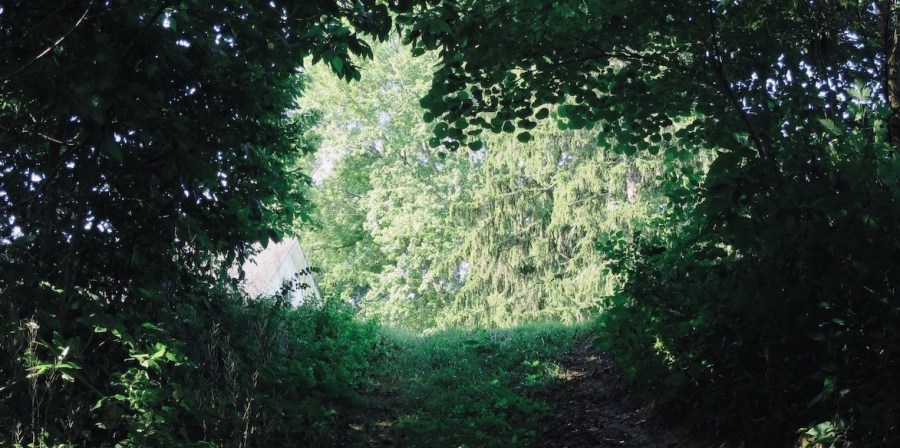
To get to the lower pasture, you have to descend through a tunnel of trees, a darkened archway that takes some faith to enter. Shadows deepen as you leave the world of fields, barns, and sunlight, and enter this shadowy crescent of land between the creek and the wooded ridge.
Down here you can no longer see the house or the cottage. The only signs of civilization are a couple of plastic Adirondack chairs overturned near a circle of rocks where we sometimes have bonfires, and a metal target my dad uses for shooting practice.
I usually only go down here to get to the creek, where I used to play when I was little, making names for sandbars like Cuttlefish Land, and finding odd bits of someone else’s life along the banks — an iron, a chandelier frame, a boot.
We have returned to this place in the Ohio countryside because — with 38 states off-limits due to rising coronavirus cases, and every vacation rental booked within a 4-state radius — we knew the cottage was empty, and even though we visited last month, my parents said, Come!
I walk down the path my dad has mowed along the creek. The creek is still now, its sloping banks dry and silent. It’s dusk, almost dark, and mosquitoes whine around my neck. Flying things keep getting caught in my hair. The trees are so loud with the razz of cicadas it seems that they are made of cymbals instead of leaves.
It’s our first night in the country, having driven 7 hours from D.C. to get here, to this house which has been in my family since 1862. After a welcome dinner of grilled hamburgers, my mom’s baked beans and potato salad, and Dairy Hut ice cream with peaches and blueberries, I have taken a walk, and since my daughter took the upper path around the soybean fields, I took the lower one.
Here in the lower pasture, it’s nothing like the land above with its brick terraces, bedspreads, and wi-fi. Where redbuds are groomed and swings are tied around oaks. The only purposeful trees down here are a few deformed walnuts getting strangled by vines. Spider silks break across my torso, and I get the feeling I’m trespassing.
I walk beside the band of walnut and tulip trees that separates upper from lower pasture. They lurch out, as if wanting to take back the land that was cleared for cows and corn. I peer into the thicket. It’s not deep but so dark, and I see why the first European settlers to North America, arriving in a place where trees took the sun, suffered from a depression called ‘green gloom.’
I mustn’t wander from my father’s mowed path of clover and wild violet. An army of young poison ivy plants has marched right up to the edge. They glow a florescent green in the falling light, and rising above the dull grasses with their forked leaves of three, they look like vampires ready to attack.
Nature is always just about to win in the country. You can repair a fence, patch a leak, trim a hedge, but the wild always returns. You can get the flying ants out, and then swarms of ladybugs will infiltrate. You can shore up the creek bank with boulders, but the water will take your land farther down. Seal up snake holes in the foundation, and bats get in through the chimney.
I pick up a bit of brown lace on the ground. A poplar leaf whose flesh has been completely devoured by caterpillars who don’t care for the veins, leaving behind an intricate skeleton, a tragedy so beautiful it might be found on the cutting room floors of a Parisian fashion house. The earth caves in as I walk and I imagine the elaborate tunnel works that moles and groundhogs have made under my feet.
Beyond the creosote post-and-rail fence at the end of the pasture, pickup trucks sail over Route 50. Their tires spin over the pavement at 55 miles per hour, barely slowing through the no-stop-light town that sits at the edge of our farm.
Where the creek goes under the highway, it joins up with the bigger one where my grandmother’s brother drowned when he was only 10 years old. A strange odor rises from the banks, and it smells sweet and rotten like boiled milk and decomposing crawdads.
It’s time to get back, and tuck in the kids. Clumps of ironweed chirp as I walk by. My grandfather used to bushhog the thistles and ironweed when there were cows in this pasture. Now there are no cows, and my parents are the grandparents.
I have to walk through the tunnel of trees up the hill once more to get home. Lightning bugs, harbingers of summer magic in the world above, blink an eerie green down here, as if signaling a witches spell.
When I emerge onto the smooth flat plain, the sky opens big over me and I feel washed with an ocean of dove-blue light. The land is an outstretched palm holding me up to the heavens. In the distance, there is Comfer’s barn where it always has been, and a band of the day’s last light hangs over the distant blue hills. The houses pour yellow light from every window, calling me home.
My grandfather loved to tell me that he was as tall as Abraham Lincoln and wore the same shoe size as George Washington. When I would come to visit, he would turn off the news, and sitting in his favorite armchair in front of the TV, he’d tell me again the story of when he left home to make his way in the world, and his dad simply said, “Be honest.”
He would tell me that when he was promoted from stock boy to cashier, he once rode his bike a mile and a half to return a dime to a customer he had overcharged. Or he might pull down a maroon leather book from the shelves and read me the poem, ‘I Am Old Glory’:
“So long as men love liberty more than life itself, so long as the principles of truth, justice and charity for all remain deeply rooted in human hearts, I shall continue to be the enduring banner of the United States of America,” of the finest country in the world.
Year after year of those sessions, of me sitting there on the living room couch, the one whose arms were always covered with plastic sleeves, while we waited for my grandmother to call “lunch,” I began to wrap that pride around my young body like a flag of bulletproof gems.
As I got older, it was easy to find appeal in sayings I heard in high school like “Russia sucks,” because enemies were anyone or anything that threatened the superpower status which gave us — me — an inflated sense of self-worth, that lifted me above and away from the dread inside, the fear that I was nothing.
Before my grandfather died, he wrote a letter to his grandchildren and one of the things he said was, “Our freedom and all the good things we enjoy must be defended constantly, every day of our lives. Always remember that a nation can be destroyed from forces within.”
“What do we want?”
“Justice!”
“When do we want it?”
“Now!”
“If we don’t get it?”
“Shut it down!”
The kids and I yelled these chants until our voices were hoarse down the streets of Georgetown during a Black Lives Matter march this June. “What are we shutting down?” asked Mark, 12, as we walked by stone houses that looked like Southern mansions, a few with white people standing in front waving.
“The system,” I tell him, but even I can’t picture it — the police, the government, the everything? I don’t know how one shuts it down or what would happen if we did.
George Floyd’s killing under the knee of a Minneapolis police officer finally shook us into reckoning that something is terribly wrong with our system — it’s rotting from within. What is festering inside our country is a caste system. This I was stunned to read in The New York Times magazine from July 5 that I had folded and saved on top of my stack of half-finished books.
The formal structure that originally defined caste was abolished with laws and civil rights acts, but the race-based hierarchy still lives on, writes Pulitzer Prize-winning author Isabel Wilkerson in her profound and elegant article, America’s Enduring Caste System.
“A caste system is … a fixed and embedded ranking of human value that sets the presumed supremacy of one group against the presumed inferiority of other groups on the basis of ancestry and often immutable traits,” Wilkerson writes, “traits that would be neutral in the abstract but are ascribed life-and-death meaning in a hierarchy favoring the dominant caste, whose forebears designed it.”
Having caste as our society’s hidden structure puts us, the world’s greatest democracy, the shining beacon of freedom, in company with India and its ancient intractable system and Nazi Germany. Invisibility, says Wilkerson, is what gives caste its power and endurance.
Wilkerson likens a caste system to the hidden structure of a house. “America is an old house,” she says, and it was built 400 years ago on a flawed foundation, a two-tiered hierarchy with those identifying as white at the top and Blacks at the bottom, while immigrants from non-European countries find a place somewhere the middle, and Native Americans are exiled completely.
As anyone who has lived in an old house knows, problems like sagging joists or water leaking into the basement don’t just go away. Sometimes we learn to live with the smell of mold and the slanted floors, and then “the awkward becomes acceptable,” says Wilkerson, “and the unacceptable become merely inconvenient. Live with it long enough, and the unthinkable becomes normal.”
A house built on a crooked foundation cannot be fixed with patches and paint. When we focus on racism as the problem, it shape-shifts, it mutates, but the invisible lines remain because, Wilkerson says, the hidden structure has not been exposed and dismantled.
I walk barefoot whenever I can these days. When the soles of my feet make contact with dirt, with bricks, with grass or even cement, I feel solid, right, part of it all.
My daughter Virginia tells me that walking barefoot on the earth is called grounding. There is something about being in touch with the ground that is healing. They say the earth’s subtle electrical charge neutralizes free radicals, acting like one giant antioxidant, and regulates our autonomic nervous system. Keeps our circadian rhythms.
Houses separate us from nature, from each other. Houses are meant to shelter us, but when some people are relegated to the basement, it may look like a dwelling from the outside but from the inside, it’s a prison to some. When the people who are kept down try to escape the place of no light, low ceilings, and toxic fumes, they are spotted immediately by their appearance. In a caste based on physical features, no amount of education, resumé heft, or hard work will set you free, because you can’t change the color of your skin.
By the laws of nature, or the universe, or what you might call God, no species is better than another. It’s one big amalgam, one mysterious overflowing swirl of life. In the animal and plant and mineral world, there are no levels of greater or lesser rainbows, adequate or inadequate sunflowers, worthy or unworthy elephants. As a native of India once told anti-slavery leader Charles Sumner, “Caste makes distinctions among creatures where God has made none.”
When my grandfather said all those wonderful things about America, I felt that I was being conferred a new sparkly costume, simply for the random involuntary act of being born on a certain patch of land. A glowing coat of beauty and power.
I must have been old enough by then to have lost that feeling I had as a child, the sense of unfettered connection with everything and everyone. I had already begun to separate myself out — good or bad, weak or strong, smart or not — judging myself with the standards and expectations that make some people into idols, others into nobodies.
I felt ashamed for my grandfather to know that I wasn’t the American that he admired and always strived to be — magnanimous, noble, fair, and true. So I took that spangled cloak and pretended I was.
MaxyM/Shutterstock
I don’t know how we can take down piece by piece a structure that contains all of us. I don’t know when we will have the courage to step down, to live without shelter, to join the wild unknown of nature, to get rid of our shoes, our buildings, our foundations.
But it helps to shine an infra-red light onto the structure we live in and ask, How much longer can we stay here before the whole thing falls down?
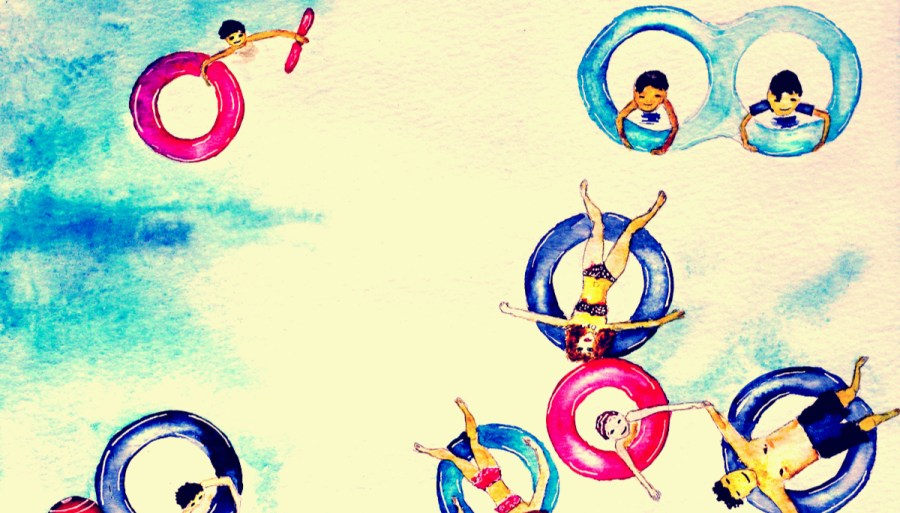
The first time we went to the pool this summer, we could only stay 20 minutes. Mark had math class on the living room computer, and I thought we’d hop in the car right after and make it for most of our slot, but he had a quiz and said it was going to take him a long time, but we said, of course we’ll wait.
Luke and Diana and I sat on the porch in our bathing suits with sunscreen on, listening to the crows caw and distant lawnmowers rove, and after a while we opened up the pool bag and looked at the hotdogs all wrapped in foil, and then we unwrapped them one by one and the mustard was so tangy, the buns so soft, and then we opened the box of carrots, and then the container of potato chips, and when Mark came out, he looked white and said there was no point, but we piled in the car and got there just in time.
But this morning Mark doesn’t have math, and we got a 2-hour reservation, and the water is sparkling like turquoise gold. The kids throw off their shorts and pull on their goggles and fast-walk to the deep end, and they’re so happy, and Sofia is coming home today, and everything is fine. So why do I feel like sitting on this vinyl lounge chair and crying?
Was it the email that came in this morning declining the invitation to celebrate Luke’s 10th birthday at an amusement park, or the shame I felt for having even asked? Is it because the thing he really wants is a bike and I can’t find a single 24-inch bike in stock to give him?
Maybe it’s because of all the money we lost on the canceled trip to Florida, or that yesterday the mayor was supposed to announce how schools would re-open but then called off the press conference, and Houston and Atlanta and L.A. and Montgomery County have already announced that school will be online this fall.
Or was it that when Virginia said she didn’t mind if her senior year was all virtual because she’s over high school, I saw a black computer screen replace her life and my redemption, my last chance to be the mom she wanted me to be, to trust her, to let her do more when high school was still high school and kids still loitered around the convenience store and rode buses and bought dresses for dances and roamed around looking for parties after football games.
“When are you going to get in?” the kids ask me, the tips of their noses dripping, their eyelashes like star points, and I tell them, “Later, I’m not hot enough yet,” but what I really mean is I’m not happy enough.
Maybe it’s because today is the day we would have flown back from Italy, bleary from too many nights out and visits to cousins and early morning cappuccinos and our suitcases would be jammed with stained sink-washed clothing and plastic bags of shells, brochures, and tiny bottles of Italian shampoo swiped from hotels.
Is it because my children have each other, but I spend my days alone, and even though I am consuming this solitude like one wide-open mouth, I feel that somewhere people are hugging and laughing and locking eyes and I’m here caught in a wind tunnel of air, so much air, fresh non-human air.
At the diving boards, kids line up to do can-openers and back dives, and I feel like a traitor, dry and motionless on my chair. I don’t know what to do with this sadness. It makes me feel soft, rich, babylike. To mourn the loss of things that others have never held.
But how does it help to not let myself cry? I become a steel drum with a welded top, my precious dangerous stuff kept in. And everyone else kept out.
After the whistle blows the long looping whine that means “get out,” lifeguards block the main entrance and masked bathers file out of the side exit by the chain link fence. I too am wet — the kids convinced me to stop wrestling with my sorrow and jump in. Near the snack bar, an enormous stack of pool chairs has been constructed, hundreds of different types and sizes that once made this a place to gather have been fitted together into one giant mass, as if ready to make a bonfire.
The remaining few set sparsely around the pool. So I couldn’t sit near anyone and pretend that I was happy. Spaced apart so that the air would fill with silence instead of chatter. So that sadness had a way to spill out and join with the rest and finally be washed away.










 Painting with Words