Diana’s legs disappear in the caramel-milk creek. She won’t climb up the fallen log because a spider with orange spots has already claimed it. Water bugs skitter over the skin of the creek, and a powder-blue moth flutters all around her and the log, its wings like pages of a book in a storm, flapping open and closed as if dying to spill its words.
“Tell it to go away!” Diana says, closing her eyes and batting the air. “I think it likes you,” I say from my position crouching on the muddy bank.
Mark and Luke run with high knees through the creek toward the highway and Greg says, “Come back and put your shoes on — there might be nails down there. People throw all sorts of stuff off that bridge!”
Diana now looks like a cross, her arms straight out, hands balled into fists. “I want the butterfly to get on me.” The boys run back, digging sticks into mud and finding truck tires in the bank. The butterfly tumbles through the thick Ohio July until it alights on Diana’s head. Its wings, the shape of a lopsided heart, the color of blue enamel, fold into one.
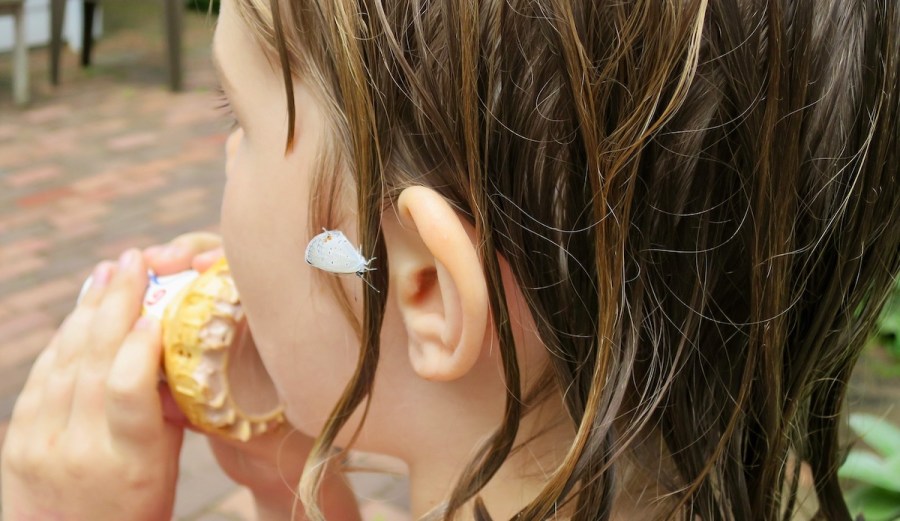
As Diana walks straight, barely moving her neck, the butterfly points skyward like a crown. It clings to clumps of her maple wet hair, even as she grabs onto a branch and climbs out, even as she runs to keep up with her brothers through the pasture to the Dairy Hut on Route 50 to get a chocolate-vanilla swirl cone.
“The butterfly got your message,” I say, when I see her coming around the bend toward the house, soft-serve smeared all over her cheeks, the butterfly clinging to her bangs like a barrette.
I can feel the skeptics in the family bristle. “There must be a perfectly rational explanation,” they would say. “The salt in the creek water, the perfume of her shampoo, the hue of her skin.”
Just before Diana’s grandmother calls her inside, the butterfly lets go and flicks around the patio. “At least you brought it up to the house, “ Luke says, “and now it can pollinate the flowers.”
Every time I pass a Black person on the street now, the encounter is charged with meaning. I look in their eyes and I feel myself saying things they cannot hear, “I’m sorry, I didn’t know, I didn’t look hard enough, I didn’t want to see, It’s too horrible, I don’t know what to do, Please don’t hate me, I’m sorry,” and sometimes they look at me back and all I hear is silence.
Three marches and a vigil, movies about race with my teenage daughter, podcasts, readings, newspaper articles. It took one man dying in a global pandemic for me to open up and see. Slavery did not end — it mutated into different forms. As an Equal Justice Initiative speaker said after a Juneteenth march, “Oppression didn’t end, it just rhymed,” finding other brutally creative expressions — aggression, repression, suppression, dispossession.
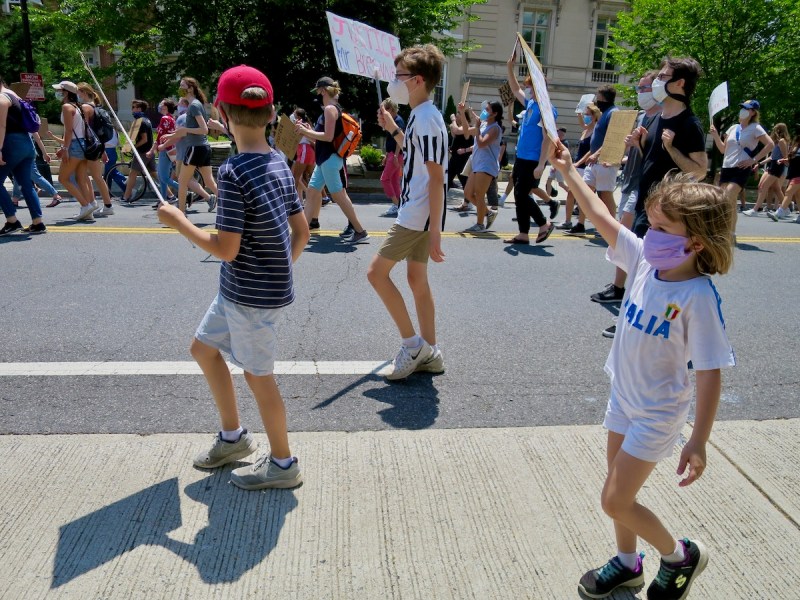
Mostly it’s white women who take pictures of my kids and me with our protest signs, but one time riding the Metro, a Black woman asked if she could snap one of the boys, who were holding onto the poles with their “Silence is Violence” and “End Police Brutality” signs. “You’re so cute,” she said as she held them in her phone’s eye, and “Thank you for your support,” and I felt like maybe this is going to work. This is a beginning.
I tell my African-American neighbor when she walks by one evening that I finally understand why she told people not to call the police on the kids loitering around the smoke shop because teens of color are usually targeted, and it becomes a way to round them up. Or why it would make sense to legalize marijuana and sex work because criminalizing them gives more reasons to lock people up when all they’re doing is trying to live, to cope.
Last week we were walking home from the grocery store, and I heard someone yelling. I turned around to see a Black man running towards us, holding something bright blue. He thrust it towards us, and I said, “Oh, thank you!” and to my son, “Mark, you forgot your umbrella!”
The man’s eyes are like those of a 9-year-old boy’s, and I say something trying to figure out what to do next, and he says, “I was panhandling outside the store,” and that was all I needed, so I fish around in my wallet and hand him a 5 dollar bill, and I look into his eyes, trying to erase everything I’d learned before and see him for him, and I say, “Thank you for your time,” and he takes it, looking down and says, “God bless you all,” and I feel dirty, like a Tammany Hall mayor, to live in a world where a grown man can tell you God bless you because you gave him a 5 dollar bill.
And I feel sick about my privilege, and I think I have to give away everything I own to make it better but even this would never make it right, and then I start to see how many people don’t feel this way, don’t feel this way at all, and in fact, feel the opposite, and I want to hide from this mess, to run away so I won’t be crushed by the massiveness of this hate, this despair, this rage, this disaster.
To be a child again, to go back to when I didn’t see any of this, before I noticed how some people were treated like animals, before I felt the dread, before I knew I was part of it, before I saw how it gouged deep canyons into our society, gorges so tall and steep, so rough and craggy you don’t dare to try to climb out.
But I cannot go back. I cannot curl up into a ball and roll back to a place where everything is smooth and soft. I must not let myself. It will never feel okay to be okay with this. And it’s okay not to feel okay. Humans are not meant to feel constant comfort and ease — we are meant to feel anguish and joy, grief and elation, struggle and triumph. We are not meant to collapse like roly-polies into little balls, winding into little gulleys until the scary guys go away.
Juneteenth March from the National Cathedral to Dupont Circle
“Black Lives Matter, huh?” an African-American man says to 6-year-old Diana, who is holding her hand-made sign as we all wait for the Metro shuttle bus in a patch of grass on Connecticut Avenue. Diana looks at him with her pug nose and brown eyes and nods.
He tells us he was at a Juneteenth march that morning, and I tell him about ours, and I feel weird about it because I feel so white and new, and on the bus, we realize he is good friends with my son’s middle school coach, and that his kids graduated from my daughters’ high school.
He mentions that he lives near the zoo, but on the other side of Rock Creek Park, which he said divides D.C. from rich and poor, white and Black, good schools and “bad” schools, and I say, I know. He went to the zoo so many times when he was little that he says he doesn’t want to go anymore — he’s all zoo-ed out, and I laugh and it feels good to laugh with him, and he tells us how he hears the lions roaring every morning, and how he wonders “if those bad boys will get out one day,” and I used to be afraid of lions escaping the zoo and jumping through my window too.
One time a few years ago I served jury duty with a group of Black and white people from all different neighborhoods over the city. By the end of the week and a half, we felt like a band of oddball cousins, eating lunch together, sharing boxes of doughnuts, and lending each other Metro cards. We cut each other slack when some of us were late, we knew each other’s quirks — Chelsea was addicted to chapstick, Rebecca packed avocado sandwiches, and Mattie stayed awake with Hot Tamales because she had quit coffee. We weren’t allowed to talk about the case, so we talked about everything else — how yellow dye #5 is made with toxic waste, whether selfies make noses look 30% wider, and why not to drink tequila in tattoo parlors.
I want to be in the room together. Not on opposite sides of the court. American life makes it so easy to separate. Thank you God for jury duty, post offices, public schools, protests, and city buses. Please help me find more ways to sit across a table and laugh about tattoos on butts and lions roaring in the morning. I want to be riding the same bus — not walking past each other on the street, exchanging cash, or looking at one another from opposite sides of the gorge.
My commitment
Seek out people of color to learn from — yoga teachers, writers, academics, film-makers, meditation teachers. Don’t fall into easy grooves, limiting my circles to people who sound like me, think like me, look like me, and grew up with the same advantages as me. Remember how reaching out a hand feels better than sitting on it. Be brave, be kind, and know that you are capable of holding big terrible beautiful things.
To watch
This week I watched the documentary 13th with my 16-year-old daughter Virginia. I highly recommend this powerful film about how America has come to have 25% of the world’s prisoners even though it only makes up 5% of the global population. The title refers to the 13th Amendment to the Constitution, which states that slavery is outlawed “except as the punishment for crime.” It’s now showing for free on Netflix and YouTube.
And the day came when the risk it took to remain tightly closed in the bud was more painful than the risk it took to bloom
On the last day of school, our high school senior was in bed in her room by herself. On Monday she had turned in her last assignment and on Wednesday she Zoomed with her last class.
While her younger siblings were having end-of-year slideshows, scavenger hunts, and superlative awards on Microsoft Teams, the last two days of the school year were spent like so many before, sitting on the living room couch next to her abandoned knitting, watching YouTube videos with headphones on.
The mayor ended the distance learning school year even before the canceled prom, senior awards, and club parties, events whose colorful blocks in our Apple calendar will float by like toy boats.
On the last day of school, I look at her by herself on the couch and feel quicksand in my chest. There were no hugs outside the front doors for her, squeezing each other with your past and your future all at once.
There were no locking eyes with the teachers that believed in you, or last glances at the ones that you didn’t care for, as if to fix them in your scrapbook too. No names being called down the hallway, some names you’ll never hear again, no clearing your locker of gross and strange things, dusty souvenirs from journeys you thought would never end.
There would be no signing of yearbooks with Sharpies, no snickering during auditorium ceremonies, no trying on of caps and gowns in the bathroom. No high fives, no last chances, no watching crushes as they walk away.
A high school career that, instead of exploding, disintegrated. Like a favorite song on the radio suffocated by waves of static as you drill into the long road ahead. Like a candle extinguished, not with a cakeful of others, but little by little in the morning damp.
The main thing that has changed is who makes lunch and who does the lunch dishes. Making school lunches used to be the weekly rotating job of Mark (12 years), Luke (9 years), and Diana (6 years). Based on ingredients I would leave out, every morning before school one of them would fill 5 plastic bento boxes, each with a lid of a different color. (Although in recent times, Virginia, 16 years, got tired of the salami sandwiches and brie with crackers and said she’d pack her own salads and smoothies.)
Now that all the kids are home during the week, the former lunch person sets the table and pours drinks at lunchtime, and the kids take turns making the meal for everyone except for Virginia, who is now vegan and usually makes her own lunch. (My husband, Enrico, works more than ever and is out of the house from early morning until late at night in his job as a hospital administrator and physician.)
When it’s Mark’s week to set the lunch table, it’s Luke’s week to clean the litterboxes (on Monday, Wednesday, and Friday), and Diana’s turn to empty the dishwasher in the morning. Then the jobs rotate, although Luke sometimes tries to get Diana to trade dishwasher for litterboxes, which only has to be done 3 times a week instead of 5.
Another new routine, suggested by the teens when schools closed and adopted at a family meeting, was that each person would do their own lunch dishes, and the person who prepared the lunch would clean the pots and pans and countertops.
Sofia (18 years) makes lunch on Monday, Luke makes lunch on Tuesday, Diana on Wednesday, Virginia on Thursday, and Mark on Friday.
The teens used to get the younger 3 kids ready for bed at night, until they traded that job for making an extra dinner per week, so I make dinner on Monday, Virginia on Tuesday, Sofia on Wednesday, me on Thursday, and on Friday, we order out from a neighborhood restaurant, one of our new pandemic traditions.
Sofia sets the table for dinner on Monday, Wednesday, and Friday, and vacuums the kitchen after dinner on Tuesday, Thursday, and Saturday, and Virginia sets the dinner table on Tuesday, Thursday, and Saturday, and vacuums after dinner on Monday, Wednesday, and Friday.
On the weekends Mark and Luke set the table and vacuum the kitchen after meals. Mark sets the table on Sunday lunch and vacuums after Saturday lunch and Sunday dinner, and Luke sets on Saturday lunch and Sunday dinner and vacuums after Sunday lunch.
The boys also take out the trash and recycling and bring the dirty laundry down to the basement, alternating week by week. I do the laundry on the weekends, and each person bring their clothes up and puts them away.
We usually have 2 dishwashers to load and unload every day, so the afternoon shift is done by Mark and Diana on Monday and Thursday, and by Luke and Diana on Tuesday and Wednesday, and only Diana on Friday.
Dinner dishes are washed by Virginia on Monday, Sofia on Tuesday, Mark on Wednesday, Luke on Thursday, and Diana on Friday (although Enrico or I usually do them for her because she still needs a stool to reach the faucets).
On the weekends, Enrico finishes meals first so he usually jumps up and does the dishes (minus the pots and butcher knives, which I usually do) and he also unloads the 4 to 5 dishwashers per weekend (except for the weird stuff — mixing bowls, whisks, carrot peelers, and baking sheets, which I do).
I make lunch on Saturday and Sunday and Sofia makes dinner on Saturday night and Virginia on Sunday night.
On Sunday, the weekly turns end and new shifts start on Monday. Monday also begins a new bathroom schedule — Mark, Luke, and Diana are assigned different bathrooms each week to get ready for bed because all that used to happen in the kids’ bathroom was playing and fighting. I usually stay with the person in the basement bathroom because no one wants that one, except for Diana who likes that bathtub better.
Diana takes a bath every Tuesday, Thursday, and Saturday, and Luke every Monday, Wednesday, and Friday, and they both take one on Sunday, except when they’ve convinced me they don’t have to, or I’m too tired to make them.
We only have 1 TV which was not a problem before the lockdown (except on weekends when Sofia and Virginia sometimes wanted to see different movies), and no one was allowed to watch on school nights anyway, unless they watched in Italian. But without friends, play practices, meetings, swim lessons, and babysitting jobs, the rules relaxed and it became clear that we needed a pandemic schedule for the TV too. It was decided that Virginia gets the TV on Monday, Wednesday, and Friday night, and Sofia gets it on Tuesday, Thursday, and Saturday night, and they alternate Sundays.
For other occasional and semi-regular jobs, like taking out the compost, cleaning baseboard moulding, and weeding the garden, we rely on our point system, where unwanted behavior (such as potty play, teasing, and bedtime-flouting) results in points which can be cancelled by doing one job per 3 points.
“Look Mama,” says Diana, 6, sitting in her high chair at the table. “I’m drawing a rainbow with sun and clouds and grass and flowers and it’s raining.”
“I’m drawing a zombie with a chainsaw in his head,” Luke, 9, says.
Then Mark, 12, says as he gets out his wooden marker caddy, “Tate was a Hazmat zombie for Halloween.”
After riding her bike on the sidewalk in front of our house, Diana, 6, stops at our weeping cherry tree, grabs some of its small bitter fruits, and says, “Now I’m going to do my spitting-far practice.”
In the spring I like to… do a easter egg hunt, die eggs, make a easter egg drawing, plant seeds, ride my bike on a walk on the streets, have popsicles outside if it is sunny and warm, eating lamb on easter, reading, writing cards to people in my family, watching my toolips open, encourage my baby boxwoods.


 Painting with Words