On the George Floyd Protests

Things cannot go on as they have
This pain needs to be felt

Old orders must die 
to make way for the new
Flowers must lose their heads 
to bloom again
Leaves have to crumple 
and fall to the ground
to give life to
spectacular and minuscule 
creatures, evolutions
happening underground

Beneath the snow 
everything seems dead 
but it is simply 
moving slowly

Nothing dies
It is waiting for us 
to see how it all fits together
How the amber sun
that presses into my skin
is the same light 
that touches you
No separation 
We are all 
creatures of the sun

Crystal by 
miraculous crystal
the snow will melt
and a new landscape —
wet and ragged —
will reveal itself
asking for another chance

What I Forget

Because we write constitutions
and fly planes and engineer sheep
I forget that we are beasts too

Because we hug slabs of silver light into the night
and wake up to a beeping bomb
I forget that we once rose with the dawn

Because we can send a rocket to Jupiter
split molecules and see our own DNA
I forget that we know nothing

Because we can build our resumés
get our degrees and tell our stories
I forget that these are just extras

Because we lock the door at night
and go into our little boxes
I forget that we don’t own anything

Things That Have Been Exchanged Since the Pandemic

Today I had to ask a neighbor to borrow a bathroom scale to weigh my children. Our pediatrician is only doing telemedicine well checks and drive-through vaccinations because Personal Protective Gear is still scarce. A scale was delivered to my porch in 15 minutes.

In our neighborhood email group of 113 houses, here is what has been asked for, received, and offered since the coronavirus pandemic arrived in mid-March:

REQUESTED

  • Newspapers to start a worm farm
  • Childcare ideas for a 6-month-old baby
  • Rainbows and notes for healthcare workers (collected by high school students)
  • A wheelbarrow
  • Masks for the neighborhood homeless shelter 
  • Birdseed
  • Quarantine-friendly care packages for two very pregnant moms
  • SCOBY (symbiotic culture of bacteria and yeast) for making Kombucha
  • Old silk ties to make a COVID Quilt

OFFERED

  • Errands, grocery shopping, and prescription pick-ups for older and immunocompromised neighbors
  • 4 skate helmets, Little League-sized bats, and a bike for a middle-schooler
  • Who to call if you see a bee swarm
  • Yard signs thanking healthcare heroes and essential workers
  • A box of books, including the Spiderwick Chronicles
  • Notary services (from the front porch and a safe social distance)
  • Weber kettle charcoal grill
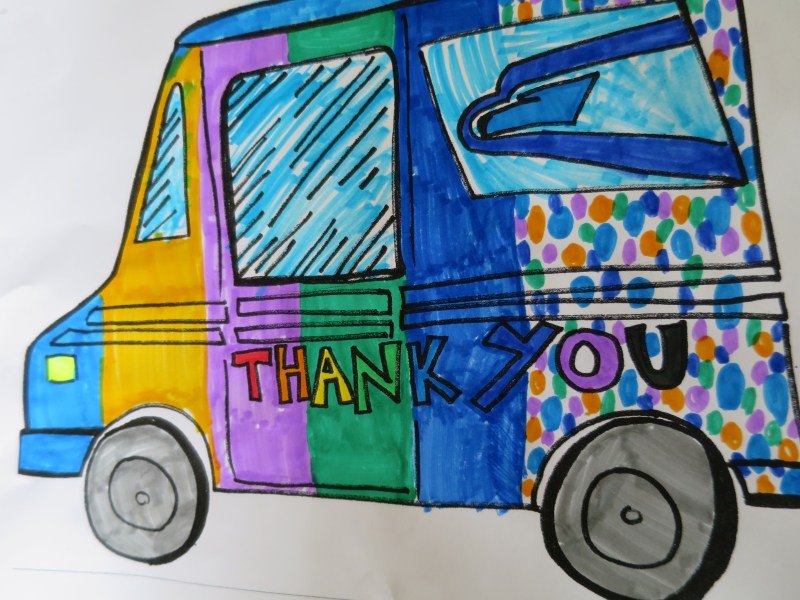
  • Hand-drawn coloring sheets to thank mail carriers and garbage truck drivers
  • Carolina slow-cooker pulled pork & slaw, Gatorade, jelly bellies, coffee, and a slew of We’re all in this together‘s for the couple who told us they had COVID-19

Remembering My War Hero

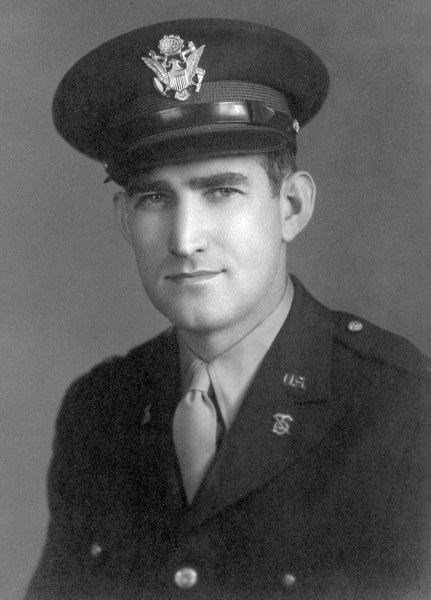
On Memorial Day, I am remembering my beloved grandfather, Wade Hampton Carden, who served in the Office of the Quartermaster General from 1942 to 1945. As a former sales manager of a grocery chain in Norfolk, Virginia, he was charged with supplying armed forces in Asia, Europe, and Africa with cigarettes, shaving supplies, toothpaste, candy, gum, soft drinks, and other things that made their lives a little easier.

At its peak, this procurement through the War Production Board required 50% of the nation’s candy bar production, 100% of the match box production, 50% of the Virginia peanut crops, 35% of the cigar production, 50% of the chewing gum, more than 50% of the razor blade production, 50% of the good fountain pens, and 100% of the popular brands of cigarette lighters.

Here is what he had to say about his service:

I was proud to have had a part in defending our country and way of life against the Germans and the Japanese. Colonel Webster, “Pop” Hover, and I were together from the beginning to the end. We saw the operation grow in volume from nothing in early 1942 to over $500,000,000 a year by 1945, serving seven million troops overseas. I was privileged to work for almost five years with a fine group of people and saw no one try to profit personally in any way. They performed their duties unselfishly with honor and trust. On leaving active service, Colonel Webster and I were awarded the Legion of Merit, and I resumed my membership in the Officers Reserve Corps, Army of the United States, as a Lieutenant Colonel.

Wade Hampton Carden

My grandfather, who I called Papa, died on August 15, 2006 at the age of 95. I still think of him a lot. Here is the eulogy I wrote for him:

Dear Papa

“Did you see the look in his eyes?” my husband Enrico asked me, referring to the photo of you that would appear with your obituary. Warm and rich, they told me unspeakable things like unconditional love. Delightfully mischievous, they reminded me of your playful nature. When Gram would remind you to take out the garbage, I remember how you would cock your head and say, “Ag, why is it that when you look at me, you think of trash?”

“What do you see in his eyes?” I asked Enrico.

“A man who has won the war.”

Yes, you did, Papa. Your resume’ tells the story of a boy who grew up barefoot on a farm in east Tennessee, took an overnight bus to Harvard Business School, married and raised three children with a beautiful schoolteacher, and rose to be one of the top executives of one of the most successful companies in the most powerful city in the world. And not only did you win, but you won your way – with honesty and integrity and respect.

You sometimes liked to point out how you were as tall as Abe Lincoln and had the same shoe size as George Washington. To your grandchildren, you were a living hero. Many people have memories of a lovable and warm grandfather, which of course you were, but what was especially unique about you was your noble character, your pride, and your intense desire to pass down your beliefs.  To borrow my husband’s words, you were “an eagle, an American eagle.”

Inside me, you are still soaring.

Pandemic Chore Schedule

The main thing that has changed is who makes lunch and who does the lunch dishes. Making school lunches used to be the weekly rotating job of Mark (12 years), Luke (9 years), and Diana (6 years). Based on ingredients I would leave out, every morning before school one of them would fill 5 plastic bento boxes, each with a lid of a different color. (Although in recent times, Virginia, 16 years, got tired of the salami sandwiches and brie with crackers and said she’d pack her own salads and smoothies.)

Now that all the kids are home during the week, the former lunch person sets the table and pours drinks at lunchtime, and the kids take turns making the meal for everyone except for Virginia, who is now vegan and usually makes her own lunch. (My husband, Enrico, works more than ever and is out of the house from early morning until late at night in his job as a hospital administrator and physician.)

When it’s Mark’s week to set the lunch table, it’s Luke’s week to clean the litterboxes (on Monday, Wednesday, and Friday), and Diana’s turn to empty the dishwasher in the morning. Then the jobs rotate, although Luke sometimes tries to get Diana to trade dishwasher for litterboxes, which only has to be done 3 times a week instead of 5.

Another new routine, suggested by the teens when schools closed and adopted at a family meeting, was that each person would do their own lunch dishes, and the person who prepared the lunch would clean the pots and pans and countertops.

Sofia (18 years) makes lunch on Monday, Luke makes lunch on Tuesday, Diana on Wednesday, Virginia on Thursday, and Mark on Friday. 

The teens used to get the younger 3 kids ready for bed at night, until they traded that job for making an extra dinner per week, so I make dinner on Monday, Virginia on Tuesday, Sofia on Wednesday, me on Thursday, and on Friday, we order out from a neighborhood restaurant, one of our new pandemic traditions

Sofia sets the table for dinner on Monday, Wednesday, and Friday, and vacuums the kitchen after dinner on Tuesday, Thursday, and Saturday, and Virginia sets the dinner table on Tuesday, Thursday, and Saturday, and vacuums after dinner on Monday, Wednesday, and Friday.

On the weekends Mark and Luke set the table and vacuum the kitchen after meals. Mark sets the table on Sunday lunch and vacuums after Saturday lunch and Sunday dinner, and Luke sets on Saturday lunch and Sunday dinner and vacuums after Sunday lunch.

The boys also take out the trash and recycling and bring the dirty laundry down to the basement, alternating week by week. I do the laundry on the weekends, and each person bring their clothes up and puts them away.

We usually have 2 dishwashers to load and unload every day, so the afternoon shift is done by Mark and Diana on Monday and Thursday, and by Luke and Diana on Tuesday and Wednesday, and only Diana on Friday.

Dinner dishes are washed by Virginia on Monday, Sofia on Tuesday, Mark on Wednesday, Luke on Thursday, and Diana on Friday (although Enrico or I usually do them for her because she still needs a stool to reach the faucets).

On the weekends, Enrico finishes meals first so he usually jumps up and does the dishes (minus the pots and butcher knives, which I usually do) and he also unloads the 4 to 5 dishwashers per weekend (except for the weird stuff — mixing bowls, whisks, carrot peelers, and baking sheets, which I do).

I make lunch on Saturday and Sunday and Sofia makes dinner on Saturday night and Virginia on Sunday night.

On Sunday, the weekly turns end and new shifts start on Monday. Monday also begins a new bathroom schedule — Mark, Luke, and Diana are assigned different bathrooms each week to get ready for bed because all that used to happen in the kids’ bathroom was playing and fighting. I usually stay with the person in the basement bathroom because no one wants that one, except for Diana who likes that bathtub better.

Diana takes a bath every Tuesday, Thursday, and Saturday, and Luke every Monday, Wednesday, and Friday, and they both take one on Sunday, except when they’ve convinced me they don’t have to, or I’m too tired to make them. 

We only have 1 TV which was not a problem before the lockdown (except on weekends when Sofia and Virginia sometimes wanted to see different movies), and no one was allowed to watch on school nights anyway, unless they watched in Italian. But without friends, play practices, meetings, swim lessons, and babysitting jobs, the rules relaxed and it became clear that we needed a pandemic schedule for the TV too. It was decided that Virginia gets the TV on Monday, Wednesday, and Friday night, and Sofia gets it on Tuesday, Thursday, and Saturday night, and they alternate Sundays.

For other occasional and semi-regular jobs, like taking out the compost, cleaning baseboard moulding, and weeding the garden, we rely on our point system, where unwanted behavior (such as potty play, teasing, and bedtime-flouting) results in points which can be cancelled by doing one job per 3 points. 

I know I’ll want to remember this one day.

A Covenant of Love

A man with a saint’s name 
called our house

He had the wrong number but,
No matter, he said, and left some scriptures
on our answering machine

Hebrews 13:5 —
“Never will I leave you;
never will I forsake you”

My teenage daughter was wondering
why I was writing down the verses —
I don’t even go to church

But I wasn’t sure it was a wrong number
or that I am an unbeliever

When my grandmother
read me Genesis
I didn’t understand 
that it was all poetry,
a magnificent design
that takes a lifetime
to unravel

Deuteronomy 7:9 —
“A covenant of love
to last a thousand
generations” 

What if this pact is not
a Father’s promise,
but that which faithfully
tells the planets how to swing
and the birds how to nest?

I want to unforget that this life
is not a bad dream
and we are not ants
wandering over an orb hurtling through space

There are no numbers that are wrong,
no disasters without regeneration,
no triumph where all is won

I must write myself out of this comic book
of thick black lines and primary colors
and walk into the fathomless story 
that is unfolding within and around me, 
the story that is still being written —
no happy endings, no sad ones,
no endings at all

Flying Coffins

When I tuck the navy blue comforter 
around Mark and ask him 
what he’s grateful for, he says, 
“Can I tell you something instead?”

“In World War II, 
there were these bombers
called B-24s and
half of them crashed 
before combat
because they were that bad.”

He and his brother had read
the story of Louis Zamperini,
Unbroken, the young reader’s edition,
that my aunt sent them 
from Texas in a box. 

“Those were the B-24 Liberators,” 
Luke says in the bunk below him,
“but they called them ‘flying coffins.’”

When I was their age,
I didn’t understand
how death could be a 
liberation.
But now I see.

It’s hard to take off
and stay on course
in these bodies, brains,
with their stiff, heavy controls —
flying coffins
destined to crash.

It gave a man religion, they said,
to fly one of those bombers.


Six years ago, they found a
B-24 Liberator
in an old pine forest in Lazio.

I wouldn’t mind if my wreckage
were scattered in those woods —
boulders pillowed with moss,
trees draping the sky,
a medieval town
clutching the hill.

Friday Night Pandemic Diary

Restaurant sign only open for take out and delivery during coronavirus

It’s become a lockdown tradition to order out on Friday night from a neighborhood restaurant. We’ve tried Mexican, Korean, French, Italian-American, Middle Eastern, Peruvian, and tonight, Indian. I wonder which of them will still be here when we emerge.

At Masala Arts, you can order the Community Package of 4 main courses, 4 breads, and 2 appetizers, and they’ll give you a free tray of 30 eggs and 4 toilet rolls. We already scored a 12-pack of Charmin mega rolls at CVS on Monday, so we go a la carte.

I tuck 2 hand-made masks into my back pocket, a credit card, and two $5 bills for homeless people we might run into on the avenue. Diana gets out her brother’s hand-me-down bike, and we head out into the goldenrod evening. 

At the top of the hill near SuperCuts, we pass a group of older teens with masks hanging off their faces. Restaurants and dry cleaners say they’re open, but Tenleytown feels empty, like it’s made of scaffolding.

When we pull open the door to the restaurant, Diana says, “There’s no one here!” Instead of a take-out and delivery operation, the place looks exactly the same as it did before the pandemic. Just the bodies are missing, as if they had been vaporized.

A man with a mask is on the phone taking another order, so we walk around, noticing the spice orange walls, the sensuous Indian sculptures, the charcoal drawings of women with real gold jewelry attached. I wish I wore jewels on my forehead and garlands of gold around my waist and ankles.

As I take our warm paper bag of food home in my arms, a bald man I’ve never seen before is resting his forehead on the Mexican restaurant patio post as if it were a walking cane. I drop $5 in his empty 20-ounce Pepsi cup, and he says, “God bless you.”

In the CVS parking lot, Duane has returned to his station on a blanket-padded milk crate, writing the next installment of The Black Fields Chronicles: THE HOBO on his cell phone. He always says “I’m blessed” when I ask how he is. I give him the second bill to help pay for dinner, we say good-bye, and Diana coasts down the hill toward home.

After we eat all the lamb korma, coconut curry chicken, and rock salt cilantro naans, Mark draws dolphins on Virginia’s feet and faces on her toes with a ballpoint pen because it feels good. Sofia starts melting chocolate chips over a pot of boiling water, and it’s time for people to get ready for bed. Virginia vacuums the rice off the floor in a knit strapless dress because it’s her turn.

When I tuck Diana in, she says, “I’m grateful that restaurants are open.” I stay in her room and write about this day while she falls asleep, because she doesn’t like sleeping alone, and because it was a beautiful, sad, special, ordinary day.

The Light Side of the Dark

Our wounds from the trauma of the pandemic have begun to flatten into a kind of scar. My grief is softening, and the boys, 12 and 9, are less like drafted rebels and more like dusty soldiers, marching through blue window after blue window to the end of each day, to the end of the school year, as if walking home after a war that no one has won.

At 11:30 each day, we always get outside, whether the kids’ work is done or not. “Let’s play soccer on Fort Reno!” Diana, 6, says, and the boys agree. Soccer is in, bikes are out.

“You guys go ahead and I’ll meet you there with lunch,” I tell them. I pack a Sullivan’s Toy Store tote with 1 poppy seed bagel sandwich, 2 sesames, and 1 bialy wrapped in foil, plus a half clamshell of strawberries, ice water in 2 old sippy cups, 4 paper towels, and just for fun, 3 Kinder Sorpresa eggs sent by their grandfather in Italy. 

When I leave for the park just a block away, Virginia, 16, is sitting on the floor of the deck eating her vegan pasta bowl, and in the basement a CorePower Yoga on-demand teacher demands heart strength and deep breaths from students who once sweated with her in a white-washed loft, and the ones like Sofia, 18, that she will never know.

I climb the hill and see the kids on the far soccer field. After days of cold and clouds, the sun bathes the hill and our tiny figures in a dome of golden light. 

As I get closer I can see Diana kicking the ball toward the goal, and Mark missing it and falling down like a clumsy marionette. 

They spot me and the boys run to me as they did when they’d see me waiting for them after school. ‘All gas, no breaks,’ as the graffiti on the retaining wall says.

“We were playing world cup soccer,” they tell me. “And sometimes one of us is an A.I. player.”

We select a picnic spot near the community garden. I am drawn to the unusual things in this ocean of grass — the orange-red poppies, bright as my grandmother’s cakey lipstick, and clumps of white irises, standing around like lieutenants.

On the courts beyond the garden, a pair lob a tennis ball back and forth. A guy hits a baseball — TING! — in the batting cage. A woman smiles at us as she walks by with a small dog on a leash.

“Yummm,” I say, and a small chorus echoes me, as we bite into bagels spread with salty buttery cream cheese. A pair of fat carpenter bees bump into each other, dive into the grass, and then fly away in a drunken helix dance. 

“Why do they fight?” Diana asks.

“Who knows what they are doing?” I say. “Maybe they are playing,” or maybe they are mating, which I don’t say because I’d rather not talk about sex.

After lunch, Mark sits on the soccer ball, the stitching busted at one of its joints. “Luke pumped it up too much,” he says.

We pack up the bag and walk home for siesta, just the 4 of us, and I feel we are like the buttercups we walk through, insignificant and yet a part of everything.

I love this peace. Not that long ago, I fought against the breakdown, the shuttering, the quarantine as if it were a militia I had to beat back so I could live. Maybe I never understood what is an enemy and what is a friend, or that maybe something can be both and neither.